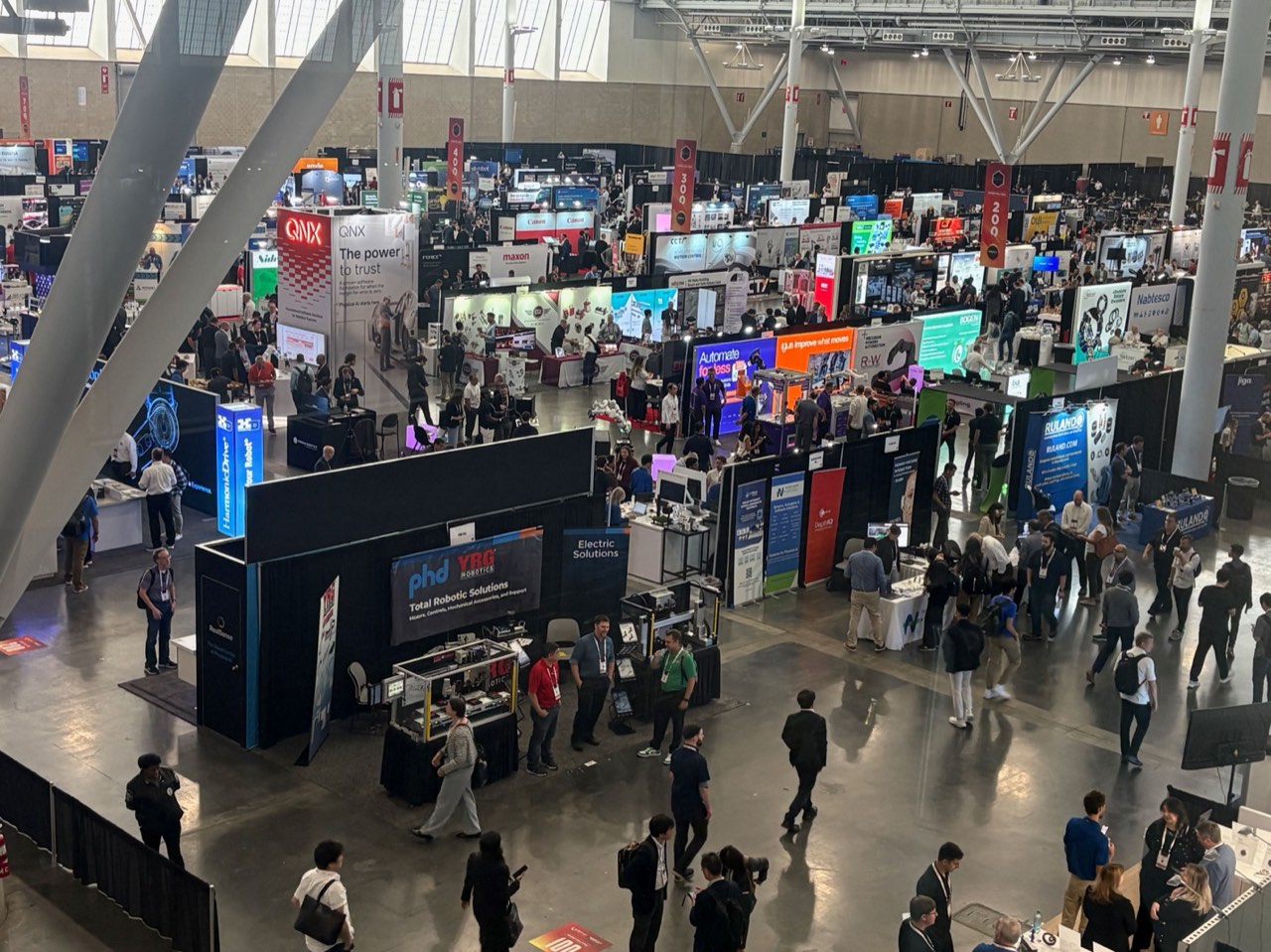
We just returned from the 2026 Robotics Summit in Boston. We attended talks, perused the floor, and talked to developers and business leaders from across the ecosystem. Since Robot Ops is focused on production robotics engineering, here's our take, filtered to a developer/devops perspective.
Maturing to production
The main stages featured several discussions around maturing to production — reliability, safety, and security. The first day's keynote featured speakers including Aaron Parness (Amazon Robotics), Anders Beck (Universal Robots), John Wall (QNX), and others. There was a candid acknowledgement of how robots coming out of labs have been able to reach 80–90% uptime, but have found it incredibly challenging to cross the threshold into any number of significant digits after 99.9%.
Cybersecurity also came up repeatedly — large fleets are still largely just securing their perimeters with firewalls rather than taking a defense-in-depth approach. In a separate talk, Ariana Eisenstein gave a transparent, in-depth look at how Pickle Robotics went from lab to production warehouse package unloading, and how they responded with real agility to maintain high reliability for critical operations.
Build systems and CI
On the devops side, we saw serious investment into build systems and CI. Andrew Stout, Brennan VanderLaan, and the team at the RAI Institute took a packed room through a comprehensive Bazel-based CI system designed so that multiple teams could contribute to and use a shared codebase with customized dependencies — critical for multidisciplinary robotics projects demanding portability — while keeping build pipelines lean and fast.
Sjoerd van der Zwaan from Solid Sands also walked engineers through continuous dependency monitoring for security and compliance within CI pipelines.
Embodied AI was the buzzword
Embodied AI was the buzzword that entered every conversation. Audiences were wowed by autonomy demos like Chris Matthieu's from RealSense, and the expo floor featured a number of companies selling purpose-specific models ready to load onto a Jetson Nano, plus training data for fine-tuning pipelines.
That excitement was tempered by cautionary notes: concerns about over-reliance on models for autonomy, poor-quality training data, and the surprising finding that too many data points can actually degrade model quality through poor signal-to-noise in weighting.
Too many data points can actually degrade model quality through poor signal-to-noise in weighting.
Simulation as a first-class tool
Supporting all of this was a notable rise in compute infrastructure. Brian Gerkey's second-day keynote highlighted how simulation technology — Gazebo, Isaac Sim, and others — has matured to the point where it's a first-class part of the development pipeline, offering high fidelity and predictability. He also emphasized the growing need for simulator interoperability, as different tools serve different purposes, environments, and teams.
One standout on the expo floor was Nick Thompson's OLO Robotics, offering a rich simulation environment with pre-built 3D robot models in an on-demand cloud setup.
It kept coming back to data
The trend toward embodied AI, combined with increased awareness of what production-grade reliability actually requires, kept bringing conversations back to data. Several panels focused on how telemetry is critical not just for performance, but for user understanding, security, safety, and model efficacy.
Panel members identified some friction points specific to robotics:
- Data tends to be siloed across multidisciplinary teams, making extraction difficult.
- There's sometimes a perception that it isn't important yet.
- Storage costs feel prohibitive.
In reality, having observability data ahead of time is exactly what enables fast root cause analysis, and storage is cheap when data is filtered correctly.
The takeaway
Overall, it was encouraging to see real momentum around production hardening as robotic systems leave the lab and enter commercial deployment. Strong practices around devops, SecOps, and observability will be key to sustaining that progress.
If your team is navigating this transition, we'd love to talk — robotops.com.